In the design of a high-performance anaerobic digester, the selection of mixing technology is perhaps the most critical technical decision. Efficient agitation directly impacts the Hydraulic Retention Time (HRT) and prevents the dreaded “dead zones” that can reduce gas production by up to 30%.
As a leading biogas plant equipment manufacturer, Vrinda Industries provides both technologies. However, understanding the technical trade-offs between Submersible Agitators and Vertical/External Mixers is essential for optimizing your plant’s Specific Gas Production (SGP).
1. Submersible Agitators: The Versatile Workhorse
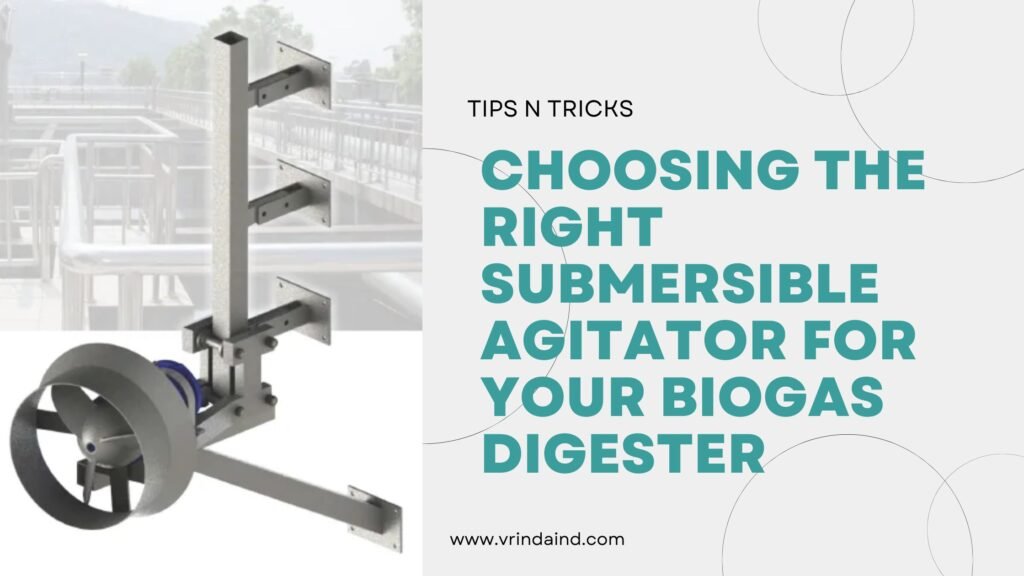
Submersible Agitators are fully immersed in the substrate. They are mounted on guide rails, allowing for adjustable depth and angle.
- Best For: High-viscosity slurries, large circular tanks, and plants requiring flexible flow patterns.
- Technical Advantage: Because they are inside the fluid, they provide direct thrust where it’s needed most. By adjusting the angle, you can effectively target surface crusts or bottom sediment.
- Energy Footprint: High thrust-to-power ratio. However, the motor operates in a harsh chemical environment.
2. Vertical / Top-Entry Agitators: The Constant Force
These units feature an external motor mounted on the digester roof or a dedicated bridge, with a long shaft extending into the slurry.
- Best For: Smaller to medium digesters, or setups where the motor must stay outside the corrosive gas zone.
- Technical Advantage: The motor is easily accessible for maintenance without opening the digester. They are excellent for creating a consistent vertical vortex.
- Limitation: They have a fixed position, which can lead to sediment buildup in large tanks.
Technical Comparison Table
| Feature | Submersible Agitator | Vertical / Top-Entry Mixer |
|---|---|---|
| Installation | Internal (Guide Rail) | External (Roof/Bridge Mounted) |
| Maintenance Access | Requires lifting unit out | Easy (Motor is outside) |
| Mixing Flexibility | High (Adjustable angle/depth) | Fixed (Stationary shaft) |
| Corrosion Risk | High (Internal motor housing) | Low (External motor) |
| Ideal Substrate | Thick Manure, Food Waste | Wastewater, Thin Slurries |
| Capital Cost (CAPEX) | Moderate | Higher (due to mounting bridge) |
3. Solving the “Dead Zone” Problem
A major challenge in organic waste management is the formation of dead zones—areas where the substrate remains stagnant. This leads to acidification and reduced methane yield.
For large-scale industrial plants, we often recommend a Hybrid Mixing Strategy:
- Submersible Agitators positioned to create a horizontal flow.
- High Flow Agitators or vertical units to maintain vertical homogeneity.
This multi-axial mixing ensures that microorganisms are in constant contact with fresh feedstock, significantly increasing the degradation rate of volatile solids.
4. Impact on ROI and Operational Life
When calculating the Total Cost of Ownership (TCO), plant managers must look beyond the initial purchase price.
- Energy Consumption: A poorly selected mixer might consume 15% more power than necessary to achieve the same mixing results.
- Downtime: Submersible units are designed with double mechanical seals to prevent liquid ingress, extending the mean time between failures (MTBF).
- Process Stability: Consistent mixing prevents “slugging” (sudden bursts of gas), which can damage gas holders and CHP engines.
Which Agitator Does Your Digester Need?
The choice ultimately depends on your Total Solids (TS) percentage and tank geometry.
- If your TS is above 8-10%, the directional power of a Submersible Agitator is usually necessary.
- For municipal wastewater or dilute industrial effluents, a Vertical Mixer offers lower maintenance overhead.
Conclusion: Engineering the Perfect Mix
At Vrinda Industries, we don’t just manufacture equipment; we engineer solutions. By understanding the fluid dynamics of your specific waste stream, we help you select the agitation technology that maximizes gas output while minimizing energy input.
Contact the technical team at Vrinda Industries today for a fluid dynamics consultation and custom equipment quote!